
Integrative Care.
Individualized Depth.
FluidiQi offers one-on-one and small group services designed to restore adaptable, efficient movement through the integration of manual therapy, structural organization, and movement re-education.
Each service is individualized and grounded in systems-based rehabilitation.
 01
01
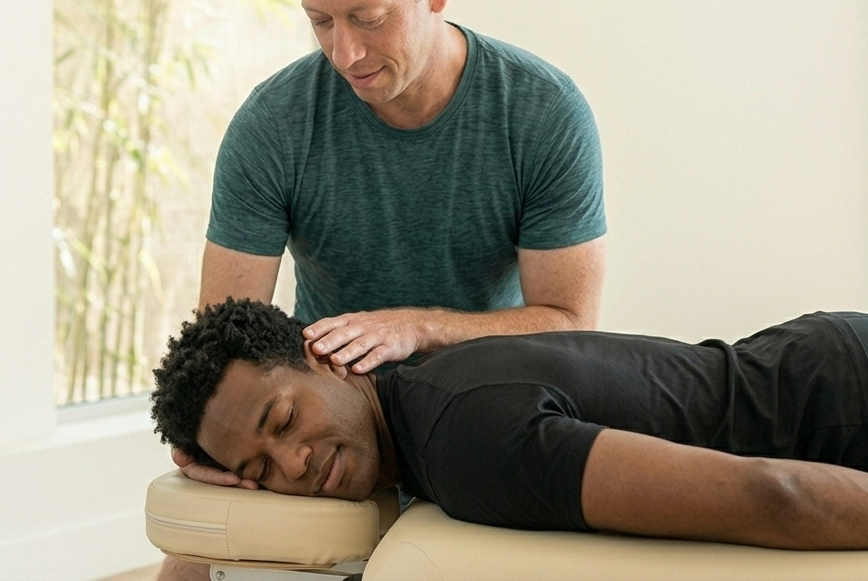
Manual Therapy
Address tissue restriction and nervous system regulation to restore efficient force distribution.
Techniques Include:
- Soft tissue & fascial mobilization
- Scar tissue work (superficial & deep)
- Bone & Cranial manual therapy
- ZOGA-influenced integration
Movement
Movement is where adaptation becomes sustainable. Restore coordination, mobility, and strength through guided integration.
Sessions Incorporate:
- Pilates-based rehabilitation
- Tai Chi and Qi Gong principles
- Neurological re-education
- Postural, breath, and gait training
- Sports rehabilitation strategies
 02
02
Integrative Group Movement
Small group sessions support ongoing mobility, strength, nervous system regulation, and structural efficiency in a guided environment.
Small Therapeutic Group
Higher individual attention. Ideal for rehabilitation, chronic pain, pelvic health, and nervous system-informed movement.
Larger Group Class
Designed for ongoing maintenance, resilience, and movement refinement. Multi-class packages available.
A Collaborative Model
FluidiQi operates within a collaborative healthcare framework—one that includes both practitioners and the individual receiving care.
Allied Referral Partners
When appropriate, care extends beyond a single discipline. We frequently coordinate with and refer to specialists across the wellness spectrum:
Participation and Agency
Care is not something done to the body, but something developed with it so that the body becomes aware of how to care for itself. This model recognizes that no single discipline—and no single approach—owns healing.
Inquiries & Insight
Clinical logistics and the philosophy of integrative care.
Is FluidiQi traditional physical therapy?
FluidiQi is grounded in Doctor of Physical Therapy training. However, it extends beyond traditional models by integrating manual therapy, structural integration, pelvic health, neurological rehabilitation, and integrative medicine within extended one-on-one sessions.
This is not a protocol-driven or volume-based model. Care is individualized and systems-based.
Do you take insurance?
FluidiQi operates as a private-pay integrative practice. This allows for:
- Extended one-on-one time
- Greater depth of assessment
- Integration across systems
- Collaborative care without insurance constraints
A superbill may be provided for potential out-of-network reimbursement. Check with your insurance provider regarding eligibility.
Do you offer Telehealth?
Yes. While manual therapy is a pillar of in-studio care, integrative movement re-education and ergonomic consultations can be conducted effectively via secure video platforms.
This is an excellent option for ongoing movement coaching or for those outside the immediate geographic area.
How long is each session?
Private sessions are a minimum of 60 minutes.
This duration allows adequate time for assessment, manual integration, movement re-education, and discussion without rushing the process.
What conditions do you treat?
FluidiQi works with individuals experiencing:
If you are unsure if your condition is a fit, schedule a consultation.
How many sessions will I need?
Care plans are individualized. Some notice meaningful change within the first session. Others with complex conditions may require ongoing collaboration to restore adaptability.
The goal is not dependency, but increased agency and self-sufficiency.
What happens in the first session?
The 90-minute first session includes:
- Comprehensive systems-based assessment
- Medical and movement history discussion
- Evaluation of alignment and compensation
- Manual therapy and/or movement integration
How is this different?
FluidiQi does not isolate systems. Care integrates structural organization, nervous system regulation, breath mechanics, behavior, and environment.
The difference lies in integration, individualized depth, and participatory rehabilitation.
Who is a good fit?
Successful outcomes occur when individuals are:
- Motivated to participate in their healing
- Open to mind-body integration
- Willing to explore new movement patterns
- Ready to build sustainable habits
Do I need a referral?
A referral is not typically required for private-pay services.
However, if you are currently under the care of another provider, collaborative communication may be encouraged.
Do you work with children?
Yes. Pediatric services may include cranial manual therapy and movement integration where appropriate.
Is this for post-surgical recovery?
Yes. Integrative manual therapy and movement re-education may support scar mobility, structural efficiency, and restoration of range of motion.
What is "Qi" in this context?
Qi can be understood as the body’s capacity to generate and distribute force: its drive and coordination.
The work relies on observable relationships between structure, nervous system regulation, and movement efficiency.
Professional Evolution
FluidiQi provides advanced clinical mentorship and instructional training for movement professionals seeking systemic mastery.
Practitioner Intensives
Advanced clinical reasoning for DPTs and bodyworkers. We focus on hands-on reorganization strategies that bridge the gap between traditional rehabilitation and fluid, integrated movement.
Instructor Mentorship
Evolve your technical eye. We help movement instructors (Pilates, Yoga, Strength) rewire their default coaching cues to prioritize the path of least resistance and behavioral alignment.
The Fluid Intelligence Workshop
Designed for professional collectives, these seminars explore the integration of vision, balance, and fluid dynamics into existing movement modalities.